Radio

Saturday, 26 December 2015

The English service at RFI


FMM headquarters at Issy-les-Moulineaux
Anthony Ravera

By RFI
French international radio first broadcast in English on the shortwave Poste Colonial station in the early 1930s. English-language broadcasting from France then existed in different organisations before becoming part of RFI when it was created in 1975.

Today, RFI is part of the France Médias Monde (FMM) group with other overseas broadcasters like France 24 and Monte Carlo Doualiya (MCD) . RFI's English-language service has over 40 journalists and producers in its Paris office with a wide network of correspondents around the world.
The English service is just one of RFI's language services, we also broadcast in Kiswahili (from Dar es Salaam), Hausa (from Lagos), Spanish, Portugese, Arabic, Chinese and Russian. Radio France Internationale as a whole has over 1,000 employees, with a global network of 600 correspondents.
Our English-language programmes are available on our website for 24 hours after they go out. You can also subscribe to podcasts of different parts of the broadcast.
Information on our frequencies (FM, Shortwave, Internet, Mobile phone, Satellite) is available on our website. Shortwave reception reports are welcome by post or email.
Our postal address is: 80 rue Camille-Desmoulins, 92130 Issy-les-Moulineaux
Our email is english.service@rfi.fr and we're also on Facebook and Twitter.

The Sound Kitchen (SATURDAY 19 DECEMBER 2015)

David Franklin/Getty Images/A Terrade
By Susan Owensby
This week on The Sound Kitchen, you’ll hear the answer to Laura Angela Bagnetto’s question about smallholder farmers in Tanzania and climate change. There’s news from the RFI Clubs, music for Christmas, and of course, the new quiz question. So click on that little “Listen” arrow above, and join in!
Hello everyone!
Welcome to The Sound Kitchen. You can catch the programme on-the-air every Saturday, at 6:15, 7:15, 14:45 and 16:45 universal time. You’ll hear the winner’s names announced and the week’s quiz question, along with all the other ingredients you have grown accustomed to: your letters and essays, “On This Day”, quirky facts and news, interviews, and great music … so be sure and tune in every Saturday.
Fabulous news! We have a shortwave frequency again! It’s 9675 kHz on the 31m band, and you can hear us between 6.00 and 7.00 UT every day. We’ve had reception reports from Algeria, Australia, Bangladesh, Canada, China, Cuba, Denmark, Germany, India, Indonesia, Japan, Kazahkstan, Latvia, Lithuania, the Netherlands, New Zealand, Nigeria, Pakistan, Peru, Sierra Leone, Sweden, the United Arab Emirates, the UK and the US, and although the frequency is “aimed” (or however that works) towards the African continent, give it a try. You never know … and be sure and send us your reception reports. Maybe we can get more time, which would be wonderful.
You can also look for our programs on WRMI (http://www.wrmi.net/) and WRN (http://www.wrn.org/listeners/). In Paris, you can hear us on World Radio Paris (http://www.worldradioparis.fr/) on DAB+. These broadcasters diffuse our programs out of the goodness of their hearts (and thank you thank you thank you WRMI, WRN, and World Radio Paris!), but unless you tell us how you heard us, we have no way of knowing … so do write and tell us how you listen to us.
Club News: We have a new official RFI English Listeners Club! The entire RFI English service extends a very warm welcome to the RFI Seven Stars Listeners Club in Chiniot, Pakistan, and Muhammad Saleem Akhtar Chadhar, the president.
To find out how you can create an RFI Club or transform your existing listening club into an RFI Club, go to the link at the bottom of this page.
This week’s quiz: On 14 November, my friend and colleague Laura Angela Bagnetto was co-chef in the Sound Kitchen. Laura Angela had just come back from Tanzania, where she spent a lot of time talking to farmers about the challenges they were facing with climate change. She asked you this question: “What is the crop that most smallholder farmers in Mweka, a small village on the slopes of Kilimanjaro, have stopped growing because of lack of water?” To find the answer, we told you to listen to that week’s Spotlight on Africa feature about climate change in Tanzania, which Laura Angela produced.
The answer is: Coffee! This is quite serious: coffee is Tanzania’s main export crop. Let’s hope this past week’s Cop21 agreement is going to work. 90 percent of the nation’s coffee farms are smallholder farms, which makes the problem also a social justice problem.
The winners this week are: Four long-time RFI Club members: Jean-Maurice Devault from Montreal, Canada; Father Steve Wara from Bamenda, Cameroon; Zenon Teles, the president of the Christian – Marxist - Leninist - Maoist Association of Listening DX-ers in Goa, India, and Ashik Eqbal from Dhaka, Bangladesh. Last but not least, new RFI Club member Muhammad Amin Laghari, who is also a member of the Asia International Radio Listener's Club in Sindh, Pakistan.
 Congratulations winners!
This week’s question ... you'll have to listen to the show to participate. You have until 25 January to enter this week's quiz. The winners will be announced on the 30 January program. When you enter, be sure you send your postal address in with your answer, and if you have one, your RFI Listeners Club membership number.
Send your answers to:
english.service@rfi.fr
or
Susan Owensby
RFI – The Sound Kitchen
80, rue Camille Desmoulins
92130 Issy-les-Moulineaux
France
or
By text … You can also send your quiz answers to The Sound Kitchen mobile phone. Dial your country’s international access code, or “ + ”, then 33 6 31 12 96 82. Don’t forget to include your mailing address in your text – and if you have one, your RFI Listeners Club membership number.

Monday, 7 December 2015

Mailbox Radio Prague 28-11-2015

Today in Mailbox: Czech Christmas carols, answers to last month's mystery Czech quiz, a brand new quiz question. Listeners/readers quoted: Karel Smolek, Meng Cheng, Sowmya Chitturi, Jahangir Alam Manto, Hans Verner Lollike, Mary Lou Krenek, P. Sivashanmugham.
Download: MP3
Hello and welcome to Mailbox, Radio Prague’s monthly programme foryour questions,views and comments. With the festive season approaching, we received this query from Karel Smolek:
“Hello Radio.cz, I need help! I am Czech living in Canada for 47 years, 
my wife is Canadian and my kids were born in Canada. We celebrate 
Czech Christmas every year and sing Christmas carols. I have a Czech 
CD and a book with Czech carols, but I am looking for a translation of the 
Czech carols into English, so that the whole family and friends could
 sing beautiful Czech carols in English.”
I’m afraid Radio Prague has no knowledge of a published translation of
Czech Christmas carols. If any of you, our listeners, have ever come
across one,
please let us know and we will share the information with Mr Smolek in Canada
and our audiences around the world.
Now let’s take a look at your answers to our last month’s quiz question. All of
them were correct this time. This is what Meng Cheng from China wrote:
“Franz Hruschka was born on 13th May 1819 in Vienna. He spent his childhood
 in České Budějovice, and moved to Graz in 1827. He was drafted in 1833 as a 
cadet of the 19th Infantry Regiment Hessen-Homburg. Franz Hruschka was 
promoted in 1857 to the major rank with the command of a local unit in
 Legnago. Major Franz Hruschka died on 8th May 1888 at his flat in the 
Palazzo Rizzi of Venezia. It's said that angina pectoris was the cause of 
his death.”
Sowmya Chitturi from India writes:
“Franz Hruschka moved with his father to Graz in 1827, where he 
attended elementary school and three years of secondary school. He 
studied the Czech language in the cadet's school as well, his Czech language
 teacher was captain lieutenant Ondřej Krček. He graduated from the 
cadet school after three years in 1836 and joined up his regiment which was
 based in Vienna.”
Jahangir Alam Manto from Bangladesh wrote:
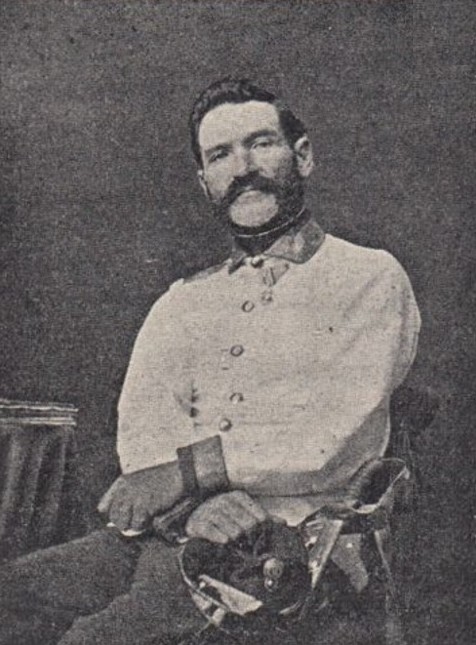
Franz Hruschka, photo: Public DomainFranz Hruschka, photo: Public Domain“In the year 1848 he joined up the marines and was 
promoted to ship sublieutenant. He is promoted to the
 major rank in 1857 and is given the command of the
 local unit in Legnago, a small city in the Verona area.
 This event ends Hruschka's army career as on 1st 
August 1865, in the year of this honey extractor
 invention, he is retired. He took as his domicile the city 
of Dolo in the Venezia area, where he had a small farm, 
which was given to his wife as a dowry. He had a son
 named Friedrich and two daughters named Antonie and 
Marie.”
This answer is from Hans Verner Lollike from Denmark:
“It is very relevant to have a person that has something 
to do with beekeeping, since that has become popular again. I heard your feature 
about bee keeping in Prague. In Denmark it has also become more popular.
“Your mystery person this time is Franz von Hruschka. He invented a honey 
extractor based on the power of centrifugation. His invention is still used today.
 The same technique had been used for years in the dairy processing for 
extracting cream out of raw milk. He presented the machine 150 years
 ago at a meeting of Austrian and German beekeepers in Brno.
“His life is a fully central European story. His family comes from Silesia, 
nowadays Poland. Born in Vienna, he spent his childhood in České Budějovice 
and Graz – joined the army and stayed in a different part of the 
Austro-Hungarian Empire. He spent his final years in Italy, spoke at least 
German, Czech and Italian. He met his future wife in Trieste, she was an 
adopted daughter of a countess. It stepped up his social rank and 
gave him some economical freedom. He became a star in his days
 among bee keepers due to his invention, but died poor and disillusioned
 after going bankrupt with a hotel in Venice. His grave is unknown.”
Our regular listener Mary Lou Krenek from Texas writes:
“He settled in Dolo, Italy where he had a small farm which had been given 
to his wife as a dowry where he became a beekeeper. He met his future
 wife in 1848 and she was as knowledgeable in beekeeping as the inventor. 
Hruschka kept himself busy in his apiary. He experimented with all 
facets of beekeeping and became quite known in the beekeeping
 world. He took part in numerous beekeepers conferences.
“The date when Hruschka came up with the 
idea of the honey extractor is unknown but we
 know for sure he did the honey harvest in
 1864 by crushing the honeycombs and 
straining the honey. In September 1865,
 Hruschka announced his invention at the 
14th German and Austrian beekeepers’ 
conference in Brno. Hruschka never claimed 
he invented the centrifugal machine but there
 is no doubt it was he who came up with the
 idea of the usage of the centrifugal force
 for gaining honey. Hruschka became known to the whole beekeeping world.
 His invention gained the finest place among beekeepers of all times.
“In his later years, he lost all interest in bees. He lost his holdings. He became
a silent loner and in the last six years of his life never went anywhere. He died 
on May 8, 1888. His funeral had an army band and many civic as well as military 
attendees. His grave was not marked by a monument; it was discontinued 
after ten years and his bones were put in a common pit. How's that for an 
end for a great inventor.”
This answer is from P. Sivashanmugham from India:
“The personality of this month is Franz von Hruschka. Major Hruschka is credited
with the invention of honey extractor. He recognised the power of centrifugal
 motion. He was a soldier, a bee keeper and hotelier. His invention of a honey 
extraction device fundamentally affected animal husbandry and bee keeping.
 Hruschka was involved in bee breeding since 1858. He announced the honey
 extractor invention at the 14th conference in Brno held on 12th to14th 
September 1865. He established contacts with the leading beekeeping 
personalities. In 1866 he did interesting experiments with a bee colony living 
without a hive; it was protected from the rain by a simple roof. He opened
 a hotel in his house in Venezia and he rented it. Hruschka went bankrupt
with his enterprise. He died in the early hours on 8th May 1888.”
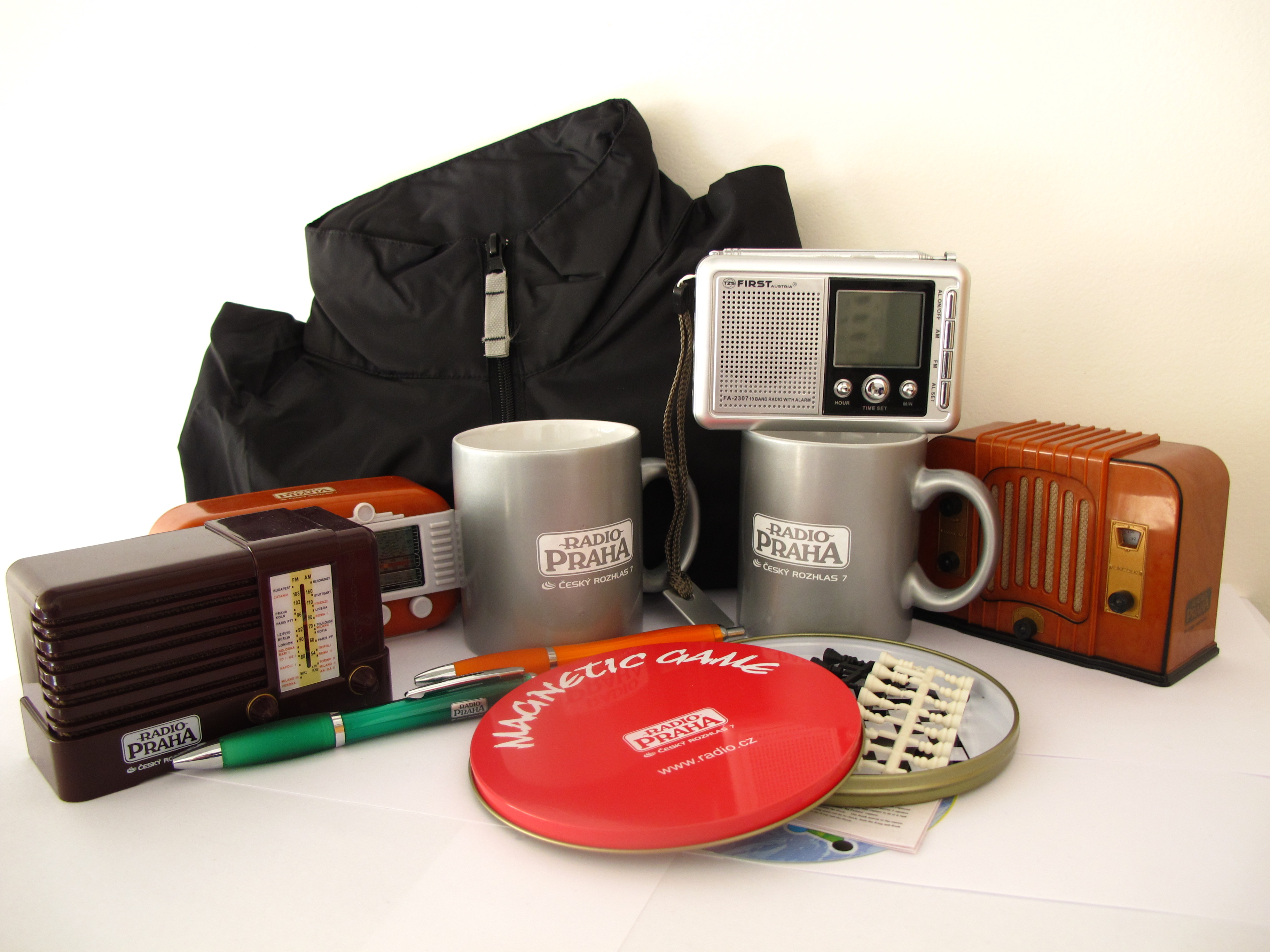
Many thanks to all of you who took part in our quiz and this time our prize
goes to Qian Xiu-ping from China. Congratulations! For those of you who
haven’t been lucky so far here’s new chance:
This time we would like you to send us the name of the Czech-born French 
tight rope walker, portrayed in a supporting part in Robert Zemeckis’ 2015 film
 “The Walk”. His character is played by Ben Kingsley.
Please send us your answers by the end of December to the usual address
english@radio.cz. You can also send us your questions, suggestions and
reception reports to the same address or leave your comments on our
Facebook page. Mailbox will be back on January 2nd. Until then happy listening
and take care.

Wednesday, 2 December 2015

Radio Prague's Monthly Quiz Winners November 2015

The correct answer for November:
Karel Zeman, photo: Ivana Vonderková Karel Zeman
Winners:
Vladimir Bondar, Ukraine
Ouni Amor Harbit, Tunisia
Tirsa García Rodríguez, Spain
Takafumi Yamanaka, Japan
Dagmar Wich, Germany
Věra Zajíčková , Czech Republic

Radio Prague's Monthly Quiz December 2015


Test your knowledge of things Czech! On the first day of the month Radio Prague will announce the month’s quiz question on this site. At the end of every month we will draw six winners from the correct answers received. Join our contest and win a Radio Prague prize! Answers should be sent to cr@radio.cz by the end of the month.
The winners will be featured on this site.
Question for December:
What are the names of the two legendary Czech travellers who undertook journeys to Africa and Latin America in the years 1947 - 1950 and to Asia and Oceania in the period 1959-1964?