Radio

Saturday, 30 January 2016

The Sound Kitchen


SATURDAY 30 JANUARY 2016
Astronauts, listener letters, Brazilian nostalgia, and looking ahead to World Radio Day

David Franklin/Getty Images/A Terrade
By Susan Owensby
This week on The Sound Kitchen, you’ll hear the answer to the question about the Soyuz Crew Capsule astronauts. There’s the listener mailbag, thoughts about the sweetness of melancholy, great music, and of course, the new quiz question. So click on that little “Listen” arrow above, and join in!
Hello everyone!
Welcome to The Sound Kitchen. You can catch the programme on-the-air every Saturday, at 6:15, 7:15, 14:45 and 16:45 universal time. You’ll hear the winner’s names announced and the week’s quiz question, along with all the other ingredients you have grown accustomed to: your letters and essays, “On This Day”, quirky facts and news, interviews, and great music … so be sure and tune in every Saturday.
I have a favor to ask of all of you. This year, World Radio Day falls on a Saturday (13 February), which means a Sound Kitchen day – and I would really appreciate it if you call our newsroom answering machine and leave us a message about what radio means to you. Just give your name and your country, and a few words about radio. I’ll put it on the Sound Kitchen as a particularly delicious appetizer, and I’ll send it to Unesco headquarters for their celebrations. Wouldn’t you like for your thoughts on radio to be heard on the United Nations Educational Scientific and Cultural Organization’s web radio? I guess so! Give us a call, at + 33 1 84 22 96 00. Radio lovers, don’t let me down!
We have a new feature! It’s a literary magazine produced once a month by Laura Angela Bagnetto, called “Africa: Stories in the 54”. Look for it here on our website, and also on The Sound Kitchen Facebook page.
Fabulous news! We have a shortwave frequency again! It’s 9675 kHz on the 31m band, and you can hear us between 6.00 and 7.00 UT every day. We’ve had reception reports from Algeria, Australia, Bangladesh, Canada, China, Cuba, Denmark, Estonia, Finland, Germany, India, Indonesia, Japan, Kazakhstan, Latvia, Lithuania, the Netherlands, New Zealand, Nigeria, Pakistan, Peru, Sierra Leone, Sweden, the United Arab Emirates, the UK and the US, and although the frequency is “aimed” (or however that works) towards the African continent, give it a try. You never know … and be sure and send us your reception reports. Maybe we can get more time, which would be wonderful.
You can also look for our programs on WRMI (http://www.wrmi.net/) and WRN (http://www.wrn.org/listeners/). In Paris, you can hear us on World Radio Paris (http://www.worldradioparis.fr/) on DAB+. These broadcasters diffuse our programs out of the goodness of their hearts (and thank you thank you thank you WRMI, WRN, and World Radio Paris!), but unless you tell us how you heard us, we have no way of knowing … so do write and tell us how you listen to us.
This week’s quiz: On 19 December, I asked you to send in the names and nationalities of the three astronauts aboard the Soyuz crew capsule. These three men left our fair planet on 15 December, for a six month mission onboard the International Space Station.
 The answer is: Tim Peake from the UK, Timothy Kopra from the US, and Yuri Malenchenko from Russia.
The winners this week are: Mrs Rokeya Khatun, the president of the RFI Surfers Society of Bangladesh in Dhaka; Rommel Tamayo Gutiérrez, president of the Cubans on the Radio Club in Holguin, Cuba; Arne Timm from Harjumaa, Estonia; Per-Allan Olsson, from Uddevalla, Sweden, and Muhammad Rashid from the Pak France International Listeners Club in Sahiwal, Pakistan.
Congratulations winners!
This week’s question ... you'll have to listen to the show to participate. You have until 29 February to enter this week's quiz. The winners will be announced on the 5 March program. When you enter, be sure you send your postal address in with your answer, and if you have one, your RFI Listeners Club membership number.
Send your answers to:
english.service@rfi.fr
or
Susan Owensby
RFI – The Sound Kitchen
80, rue Camille Desmoulins
92130 Issy-les-Moulineaux
France
or
By text … You can also send your quiz answers to The Sound Kitchen mobile phone. Dial your country’s international access code, or “ + ”, then 33 6 31 12 96 82. Don’t forget to include your mailing address in your text – and if you have one, your RFI Listeners Club membership number.

Saturday, 23 January 2016

The Sound Kitchen

Saturday 23 January 2016
French elections, the smallest democracy in the world and looking ahead to World Radio Day
David Franklin/Getty Images/A Terrade
By Susan Owensby
This week on The Sound Kitchen, you’ll hear the answer to the question about the first round in France’s regional elections. You’ll hear about the least populated national jurisdiction in the world (54 people!), listen to some great music, and of course, there’s the new quiz question. So click on that little “Listen” arrow above, and join in!
Hello everyone!
Welcome to The Sound Kitchen. You can catch the programme on-the-air every Saturday, at 6:15, 7:15, 14:45 and 16:45 universal time. You’ll hear the winner’s names announced and the week’s quiz question, along with all the other ingredients you have grown accustomed to: your letters and essays, “On This Day”, quirky facts and news, interviews, and great music … so be sure and tune in every Saturday.
I have a favour to ask of all of you. This year, World Radio Day falls on Saturday 13 February, which means a Sound Kitchen day – and I would really appreciate it if you would call our newsroom answering machine and leave us a message about what radio means to you. Just give your name and your country, and a few words about radio. I’ll put it on the Sound Kitchen as a particularly delicious appetizer, and I’ll send it to Unesco headquarters too, for their celebrations. Wouldn’t you like for your thoughts on radio to be heard on the United Nations Educational Scientific and Cultural Organization’s web radio? I guess so! Give us a call, at + 33 1 84 22 96 00. Radio lovers, don’t let me down!
We have a new feature! It’s a literary magazine produced once a month by Laura
Listen to Africa: Stories in the 54 Episode 1
Africa: Stories in the 54 Episode 1
 
19/01/2016
by Laura Angela Bagnetto
 
 
Angela Bagnetto, called “Africa: Stories in the 54”. Look for it here on our website, and also on The Sound Kitchen Facebook page.
Fabulous news! We have a shortwave frequency again! It’s 9675 kHz on the 31m band, and you can hear us between 6.00 and 7.00 UT every day. We’ve had reception reports from Algeria, Australia, Bangladesh, Canada, China, Cuba, Denmark, Estonia, Finland, Germany, India, Indonesia, Japan, Kazakhstan, Latvia, Lithuania, the Netherlands, New Zealand, Nigeria, Pakistan, Peru, Sierra Leone, Sweden, the United Arab Emirates, the UK and the US, and although the frequency is “aimed” (or however that works) towards the African continent, give it a try. You never know … and be sure and send us your reception reports. Maybe we can get more time, which would be wonderful.
You can also look for our programs on WRMI (http://www.wrmi.net/) and WRN (http://www.wrn.org/listeners/). In Paris, you can hear us on World Radio Paris (http://www.worldradioparis.fr/) on DAB+. These broadcasters diffuse our programs out of the goodness of their hearts (and thank you thank you thank you WRMI, WRN, and World Radio Paris!), but unless you tell us how you heard us, we have no way of knowing … so do write and tell us how you listen to us.
This week’s quiz: On 12 December, I asked you a question about French politics. That week we voted for our regional councils, which are in charge of transport, economic development and running public schools. I asked you to write in with the percentage of votes the three main parties won - the National Front, the Socialist Party, and the Republicans.
 The answer is: 28 % for the far-right National Front party, 27% for the center right Republicans, and 23.5 % for the Socialist Party.
The second round was on 13 December, and the National Front was defeated. The Republicans won 40 percent of the votes and the Socialists 29 percent. There are 13 regions in France: seven went to the Republicans, five to the Socialists, and the nationalist For Corsica party won Corsica.
The winners this week are: Two from Bangladesh: Rebaka Sultana Sonju from Rangpur and Mrs Mina Khanam, a member of the RFI Friends Radio Club in Naogaon. Two winners from India this week, both RFI Listeners Club members: Soma Choudhury Sarkar from Murshidabad and M Ganesan from Goa. Last but not least, another RFI Listening Club member, Mr Ralf Urbanczyk from Eiselben, Germany.
Congratulations winners!
This week’s question ... you'll have to listen to the show to participate. You have until 22 February to enter this week's quiz. The winners will be announced on the 27 February program. When you enter, be sure you send your postal address in with your answer, and if you have one, your RFI Listeners Club membership number.
Send your answers to:
english.service@rfi.fr
or
Susan Owensby
RFI – The Sound Kitchen
80, rue Camille Desmoulins
92130 Issy-les-Moulineaux
France
or
By text … You can also send your quiz answers to The Sound Kitchen mobile phone. Dial your country’s international access code, or “ + ”, then 33 6 31 12 96 82. Don’t forget to include your mailing address in your text – and if you have one, your RFI Listeners Club membership number.
 

Monday, 18 January 2016

PRINT PUBLICATION REVIEW – WORLD RADIO TV HANDBOOK – 70TH EDITION – DECEMBER 2015


Declaring itself as “The World’s most comprehensive and up-to-date Guide to Broadcasting”, this annual reference (WRTH) of 672 pages is a very comprehensive directory of world longwave, mediumwave, and shortwave radio and TV broadcasting, with its principal Sections being:
  • Features
  • World Maps
  • Equipment Reviews
  • National Radio
  • International Radio
  • Frequency Lists
  • Clandestine and other target broadcasters
  • National Television
  • References
Principal sub-chapters include
  • Brief History of the WRTH
  • History of Mediumwave and Longwave broadcasting in the UK
  • 70 Years of Receivers
  • Receiver Reviews for 2016
  • Radio in Timor-Leste
  • Future of Shortwave Broadcasting
  • Guide to Software Defined Receivers – what they are how they work
  • HF Broadcasting Reception Conditions expected during 2016
  • Clubs and Internet Resources for International Listeners and “DXers”
  • International and Domestic Transmitter Sites
  • Standard Time and Frequency Transmissions
  • International Broadcasting Organizations
  • 12 pages of advertising.
WRTH expresses concern at the continuing and steady decline of traditional shortwave and mediumwave broadcasting worldwide, implying that this is now a legacy of the past, being quickly overtaken by modern distribution platforms such as the internet, streaming audio and video, and mobile technology.

Earlier editions of WRTH featured excellent reviews of newly released general communications receivers – only four are described for 2016, CC Skywave, AOR AR–DV1, Eton Satellit Grundig, and the Tecson PL-680, with no new desktop receivers.

Readers are reminded that modern high-grade receivers now incorporate new and emerging digital design technology, known as Digital System Processing (DSP) supplanting classical analogue functions. DSP architectures are being developed to allow for the expansion of Software Defined Radio (SDR) capability,where PCs are used for down-conversion of signal output to PCs. Unfortunately, DSP equipment remains essentially in the realm of professional monitors, the military, engineering institutions, broadcasters and government organizations, out of reach to general radio monitoring enthusiasts with limited means, due to the very high initial cost and ongoing maintenance requirements.

Study of the listings in WRTH also suggests that high frequency Digital Radio Mondiale (DRM) technology appears to have stagnated due to lack of ready acceptance of this modulation system for long-distance multi-hop transmission, even though some broadcasters are continuing to persevere with what is being regarded across the industry as a redundant technology not supported by the availability of any inexpensive consumer-level receivers. HF DRM is now  mainly used for the delivery of content for national short-distance point-to-point rebroadcasting and it could be inferred as ludicrous that DRM is being maintained under such circumstances. The US BBG/IBB does not use this technology and Broadcast Australia/Radio Australia abandoned it during 2015.

Readers will also note the  reduced number of subscription (fee)-based Clubs for listeners, and perceptive users could infer that traditional “DX Clubs” may no longer be relevant, nor serve any real purpose. Some of the entries appear to be small localized “Listening Clubs” in the South Asian region, supporting selected international shortwave broadcasters. A few long-established monitoring clubs are represented by display advertisements. The number of long-established subscription–based Clubs offering both print or on-line material has trended upwards.

The listing of “Selected Internet Resources for Radio Listeners and DXers” indicates the increased use of electronic means of information exchange between enthusiasts – many of these entries included personal Weblogs or Websites and free Email lists and Bulletin Boards.

In particular, radio listening enthusiasts who entered the radio listening hobby in the 1940s and 1950s will appreciate the descriptions of selected general-coverage communications receivers, by the overview of trends in receiver technology, design, manufacture, performance, history and availabilityover 70 years. The transition from valve-type superheterodynes to solid-state transistorised solid-state techniques marked a major shift in the evolution of radio receiver design, which introduced remarkable improvement in operational performance. WRTH traces the development of frequency synthesizers and the phase-locked-loop (PLL), techniques which survive to the present.

Some 60% of the 12 pages of diaplay advertising pages include infornation from equipment manufacturers and distributors reinforces the industry movement away from “classical” analogue receiver design techniques. The remainder are promotions for radio monitoring organizations.

This directory would be of interest to anyone with an affinity or involvement with radio/TV broadcasting, ranging from the casual listener to professional monitors.

Free updates are available on-line throughout the year from the WRTH Website, www.wrth.com.

Copies may be ordered direct from the Publisher, or through selected booksellers worldwide.

Sunday, 17 January 2016

Icons of Slovakia- First round


11. 01. 2016 12:28
Welcome to the first round of our new competition called „Icons of Slovakia". In this series we're focusing on everything representing Slovakia, from musical instruments to mountains and well-known athletes. There are interesting Slovak prizes to be won, so get your pen and paper ready. Here we go!

Competition Round 1.mp3 Stiahnuť audio súbor

If you paid close attention, you shouldn't have any problems answering the competition question:
What is Slovakia's official state symbol?

You can email your answers to englishsection@slovakradio.sk or via regular post to:
Radio Slovakia International
English Section
Mytna 1, P.O. BOX 55
Bratislava 817 55
Slovakia
This round of the competition closes on January 31st, 2016.

The Sound Kitchen

Saturday 16 January 2016
Cop21 and Tamil Nadu 'right conduct' celebrations
 
David Franklin/Getty Images/A Terrade
By Susan Owensby
This week on The Sound Kitchen, you’ll hear the answer to the question about the Cop21 conference in Paris. There’s “On This Day”, plenty of great music, and of course, the new quiz question. So click on that little “Listen” arrow above, and join in!
Hello everyone!
Welcome to The Sound Kitchen. You can catch the programme on-the-air every Saturday, at 6:15, 7:15, 14:45 and 16:45 universal time. You’ll hear the winner’s names announced and the week’s quiz question, along with all the other ingredients you have grown accustomed to: your letters and essays, “On This Day”, quirky facts and news, interviews, and great music … so be sure and tune in every Saturday.
Click here to read more articles
Fabulous news! We have a shortwave frequency again! It’s 9675 kHz on the 31m band, and you can hear us between 6.00 and 7.00 UT every day. We’ve had reception reports from Algeria, Australia, Bangladesh, Canada, China, Cuba, Denmark, Estonia, Finland, Germany, India, Indonesia, Japan, Kazakhstan, Latvia, Lithuania, the Netherlands, New Zealand, Nigeria, Pakistan, Peru, Sierra Leone, Sweden, the United Arab Emirates, the UK and the US, and although the frequency is “aimed” (or however that works) towards the African continent, give it a try. You never know … and be sure and send us your reception reports. Maybe we can get more time, which would be wonderful.
You can also look for our programs on WRMI (http://www.wrmi.net/) and WRN (http://www.wrn.org/listeners/). In Paris, you can hear us on World Radio Paris (http://www.worldradioparis.fr/) on DAB+. These broadcasters diffuse our programs out of the goodness of their hearts (and thank you thank you thank you WRMI, WRN, and World Radio Paris!), but unless you tell us how you heard us, we have no way of knowing … so do write and tell us how you listen to us.
This week’s quiz: On 5 December, I asked you a question about Cop21, the Conference of the Parties to the UN Framework on Climate Change. The number “21” refers to the fact that it was the 21st Conference.
On 5 December that huge 21st conference was going on here in Paris, attended by 195 nations (and excellently reported on by RFI English’s Laura Angela Bagnetto and Rosslyn Hyams). You were to write in and tell me what the centigrade limit all 195 nations were to agree upon, in order to cut global warming.
The answer is: Quite simply, two degrees centigrade.
The negotiators succeeded! An agreement was made by all 195 countries to reduce global carbon emissions and to keep global temperatures from going up over two degrees from the global temperature before the Industrial Revolution, which began in 1861. When the Industrial Revolution began, global warming began, due to the use of fossil fuels (mainly, coal and gas) used by factories. Soon thereafter, private homes began to have electricity, and most of electricity comes from burning fossil fuels, too. And then, there’s our cars … fossil fuels emit what is called “greenhouse gases”: greenhouse gas emissions trap heat (just like a greenhouse for plants) and make the planet warmer.
What happens when the planet becomes warmer? Drought – as in Ethiopia, for example. Desertification. More heavy rains. More forest fires. And a rise in sea levels. All this is due to our current level of global temperature rise, which is close to one degree from pre-Industrial Revolution levels. So you see, we are almost halfway there already!
The 195 countries which signed the Cop21 agreed to keep global temperatures "well below" two degrees from pre-industrial times, and "endeavour to limit" them even more, to 1.5 degrees.
There were also financial agreements (which has always been one of the hardest and “what is fair?” issues): rich countries are to help poorer nations by providing "climate finance" so that they can adapt to climate change and switch to renewable energy.
It’s a pretty complicated issue … I hope I have explained it (fairly!) well. Many thanks to my friend and colleague Laura Angela Bagnetto for helping.
The winners this week are: RFI listeners Club member Dr DW Nabi from Middlesex, UK; Rabeya Begam, a member of the Nilshagor RFI Fan Club in Nilphamari, Bangladesh; Azam Ali Soomro from Sindh, Pakistan; Fansu Bolong Janneh from Banjul,The Gambia, and Royse Cramton from Oak Park, Illinois, in the US. .
Congratulations winners!
This week’s question ... you'll have to listen to the show to participate. You have until 15 February to enter this week's quiz. The winners will be announced on the 20 February program. When you enter, be sure you send your postal address in with your answer, and if you have one, your RFI Listeners Club membership number.
Send your answers to:
english.service@rfi.fr
or
Susan Owensby
RFI – The Sound Kitchen
80, rue Camille Desmoulins
92130 Issy-les-Moulineaux
France
or
By text … You can also send your quiz answers to The Sound Kitchen mobile phone. Dial your country’s international access code, or “ + ”, then 33 6 31 12 96 82. Don’t forget to include your mailing address in your text – and if you have one, your RFI Listeners Club membership number.

KBS World Radio English Service

Hey all! Let's all congratulate our last week's Y2C winner: Rabiul Hoq Kowser. Please email us your mailing address to kpop@kbs.co.kro so we can send out your prize. Be sure to include in the subject line that you are the Y2C winner for January 15th.
Now for this week's question...
Amidst all the popularity of hip hop and rap music in Korea, who do you think is the best rapper?
It can be a male rapper or female rapper. It can be for whatever reason you think is important. Maybe it's because they have the best rapping voice, best lyrics, best stage presence, best hip hop name, best visuals.
Name your choice for the best hip hop artist/rapper in Korea!!
Can't wait to hear your answers!
Tune into K-Pop Connection, like always. wink emoticon And have a great week!
-Angie

Friday, 15 January 2016

RVA urdu Service

Quiz for the month of January 2016:
Q: Which is the biggest ocean in the world?
Options:
1. Pacific Ocean
2. Atlantic Ocean
3. Indian Ocean
(Note: The last date to participate in this contest 28th Jan, 2016)

Wednesday, 13 January 2016

The Sound Kitchen

    SATURDAY 09 JANUARY 2016
Your good 2016 resolutions

By Susan Owensby
This week on The Sound Kitchen, you’ll hear the answer to the question about the Argentinian presidential election. There’s your New Year’s resolutions, plenty of great music, and of course, the new quiz question. So click on that little “Listen” arrow above, and join in!
Hello everyone!
Welcome to The Sound Kitchen. You can catch the programme on-the-air every Saturday at 6:15, 7:15, 14:45 and 16:45 universal time. You’ll hear the winner’s names announced and the week’s quiz question, along with all the other ingredients you have grown accustomed to: your letters and essays, “On This Day”, quirky facts and news, interviews, and great music … so be sure and tune in every Saturday.
Fabulous news! We have a shortwave frequency again! It’s 9675 kHz on the 31m band, and you can hear us between 6.00 and 7.00 UT every day. We’ve had reception reports from Algeria, Australia, Bangladesh, Canada, China, Cuba, Denmark, Estonia, Germany, India, Indonesia, Japan, Kazakhstan, Latvia, Lithuania, the Netherlands, New Zealand, Nigeria, Pakistan, Peru, Sierra Leone, Sweden, the United Arab Emirates, the UK and the US, and although the frequency is “aimed” (or however that works) towards the African continent, give it a try. You never know … and be sure and send us your reception reports. Maybe we can get more time, which would be wonderful.
You can also look for our programs on WRMI (http://www.wrmi.net/) and WRN (http://www.wrn.org/listeners/). In Paris, you can hear us on World Radio Paris (http://www.worldradioparis.fr/) on DAB+. These broadcasters diffuse our programs out of the goodness of their hearts (and thank you thank you thank you WRMI, WRN, and World Radio Paris!), but unless you tell us how you heard us, we have no way of knowing … so do write and tell us how you listen to us.
This week’s quiz: On 28 November, I asked you a question about Argentina’s presidential election. You were to send in the name of the new president, as well as the name of the defeated candidate.
The answer is: Mauricio Macri is the name of the new president of Argentina (he was inaugurated on 10 December). Macri defeated Daniel Scioli, who is a close ally of the country’s former president, Cristina Fernandez de Kirchner.
The winners this week are: A brand-new contributor to the Sound Kitchen: Aidan Wynne, who lives in Calabar, Cross River State in Nigeria (look for his picture on the RFI English and The Sound Kitchen FaceBook pages). From India, Ms Sowmya Chitturi from Hyderabad and Sagrika Sharma from Jharkhand. From Naogaon, Bangladesh, Mrs Esha Khanam, and finally, Obrayan Cruz Garcia, a member of the RFI Club Cuba in Holguin, Cuba.
Congratulations winners!
This week’s question ... you'll have to listen to the show to participate. You have until 8 February to enter this week's quiz. The winners will be announced on the 13 February programme. When you enter, be sure you send your postal address in with your answer, and if you have one, your RFI Listeners Club membership number.
Send your answers to:
english.service@rfi.fr
or
Susan Owensby
RFI – The Sound Kitchen
80, rue Camille Desmoulins
92130 Issy-les-Moulineaux
France
or
By text … You can also send your quiz answers to The Sound Kitchen mobile phone. Dial your country’s international access code, or “ + ”, then 33 6 31 12 96 82. Don’t forget to include your mailing address in your text – and if you have one, your RFI Listeners Club membership number.

Tuesday, 5 January 2016

The Sound Kitchen

Saturday 02 January 2016
I scream, you scream, we all scream for - GUIGNOL ! 

David Franklin/Getty Images/A Terrade
By Susan Owensby
This week on The Sound Kitchen, you’ll hear about the traditional French puppet “Guignol”. You’ll also hear what is possibly the most beautiful vocal quartet ever written, so click on that little “Listen” arrow above, and join in!
Hello everyone!
Welcome to The Sound Kitchen. You can catch the programme on-the-air every Saturday, at 6:15, 7:15, 14:45 and 16:45 universal time. You’ll hear the winner’s names announced and the week’s quiz question, along with all the other ingredients you have grown accustomed to: your letters and essays, “On This Day”, quirky facts and news, interviews, and great music … so be sure and tune in every Saturday.
Fabulous news! We have a shortwave frequency again! It’s 9675 kHz on the 31m band, and you can hear us between 6.00 and 7.00 UT every day. We’ve had reception reports from Algeria, Australia, Bangladesh, Canada, China, Cuba, Denmark, Germany, India, Indonesia, Japan, Kazahkstan, Latvia, Lithuania, the Netherlands, New Zealand, Nigeria, Pakistan, Peru, Sierra Leone, Sweden, the United Arab Emirates, the UK and the US, and although the frequency is “aimed” (or however that works) towards the African continent, give it a try. You never know … and be sure and send us your reception reports. Maybe we can get more time, which would be wonderful.
You can also look for our programs on WRMI (http://www.wrmi.net/) and WRN (http://www.wrn.org/listeners/). In Paris, you can hear us on World Radio Paris (http://www.worldradioparis.fr/) on DAB+. These broadcasters diffuse our programs out of the goodness of their hearts (and thank you thank you thank you WRMI, WRN, and World Radio Paris!), but unless you tell us how you heard us, we have no way of knowing … so do write and tell us how you listen to us.
This week’s quiz: time for a little holiday break. The quizzes resume next week, on 9 January.

To find out how you can win an RFI wireless computer mouse or Mp3 player, click here:
http://www.english.rfi.fr/culture/20141218-sound-kitchen-essay-contests

Radio Prague MailBox 02-01-2016

Today in Mailbox: Christmas and New Year's greetings, Christmas programmes, reception reports, answers to last month's quiz question. Listeners/readers quoted: Chrissy Brand, Simon-Peter Liehr, Richard Nowak, Juan Carlos Gil Mongio, Meng Cheng, Qian Xiu-ping, Mofizur Rahman, Hans Verner Lollike, Jayanta Chakrabarty, Mary Lou Krenek, Arne Timm.
Download: MP3
Photo: archive of Radio PraguePhoto: archive of Radio Prague Hello and welcome to the first Mailbox in 2016! Thank you for the multitude of Christmas and New Year’s greetings and wishes. May you, our listeners, have a happy and fruitful 2016, too! Radio Prague is happy to keep you company.
Among those greetings we received this lovely e-mail from Chrissy Brand from England:
“Thank you so much for another year of fantastic programmes. You are an international broadcaster that leads the way with such a good variety of both quality and quantity when it comes to programmes. If only more broadcasters would follow your example.
“I particularly enjoy Panorama with its range of national and international coverage (for instance on your President's scary anti-Muslim stance and the refusal to appoint professors, and the Myanmar election) and, at the other end of the scale, the simple idea (but such a clever one) of My Prague, is wonderful.
“In fact I am slowly working my way through all the episodes I have missed. It has made me determined to return to Prague and the Czech Republic for a holiday in 2016. Perhaps you could extend the programme by sometimes going to other cities and rural communities in your country?
“I used to listen to you on shortwave but that seems impossible these days. So, at least once a week, I download your daily broadcasts and selections from your archives. I then listen to them as I am commuting around my hometown of Manchester or on long train journeys around the UK.
“Wishing all at Radio Prague and all your listeners a merry festive period and a happy and healthy 2016.”
We are always interested to know where and how you listen to our programmes. Here’s what Simon-Peter Liehr wrote:
“Greetings from Germany! Great that Radio Prague’s news in English can be heard via Czech medium wave in Europe now! Here is my reception report. Please note also the transmitter site - Domamil (Moravské Budějovice) - on your QSL card. Thank you very much in advance!”
Richard Nowak from Florida sent us this:
Photo: Martina SchneibergováPhoto: Martina Schneibergová “The Christmas Music show ‘A Czech Christmas’ was outstanding! I enjoyed everything, this was great! Thanks for the show and your support of shortwave!”
Thank you for your feedback, it is much appreciated. And now onto our monthly quiz. The correct answer to last month’s question is neither Philippe Petit nor Joseph Gordon-Levitt but rather :
“Rudy Omankowski, Jr. is the Czech tight rope walker. I had not heard about him before, so I searched online and found a documentary about his walk between the Twin Towers entitled ‘Man on Wire’. It is very exciting and it seems to be a [feature] film, not ‘only’ a documentary. I hope ‘The Walk’ to be presented in my city to watch it.”
…writes Juan Carlos Gil Mongio from Spain in his reception report. Meng Cheng from China wrote:
“My answer to this month's quiz question is: Rudolf Omankowsky, who's also known as Papa Rudy. Rudolf Omankowsky is the Czech-born French tight rope walker, who is portrayed in a supporting part in Robert Zemeckis’ 2015 film ‘The Walk’. In this 3D film, Rudolf Omankowsky is played by Ben Kingsley.”
Qian Xiu-ping from China wrote:
“From to the three clues of ‘Czech-born French tight rope walker’, ‘a supporting part in Robert Zemeckis’ 2015 film 'The Walk’, and ‘His character is played by Ben Kingsley’, I've successfully guessed that the mysterious person is Rudolf Omankowsky, aka Papa Rudy. I'm very sure it is the very correct answer to your quiz question.”
Mofizur Rahman from Bangladesh writes:
“Omankowsky was the patriarch of a successful group of wire walkers who performed in France and throughout Europe. His wife Anna Tříska, and their children, Rudy Jr., Berty, and Lili were known as Les Diables Blancs.
“In 1954, Rudy Omankowski made headlines when his daughter Berty married Roger Decugis in ceremony conducted on high wires above the streets of Toulouse, France.
“Omankowski is now a high wire teacher at the Centre Nationale des Arts du Cirque in Châlons-en-Champagne, France, and has mentored many prominent high wire and circus artists, including Didier Pasquette, Jade Kindar-Martin and Molly Saudek.”
This answer is from Hans Verner Lollike from Denmark:
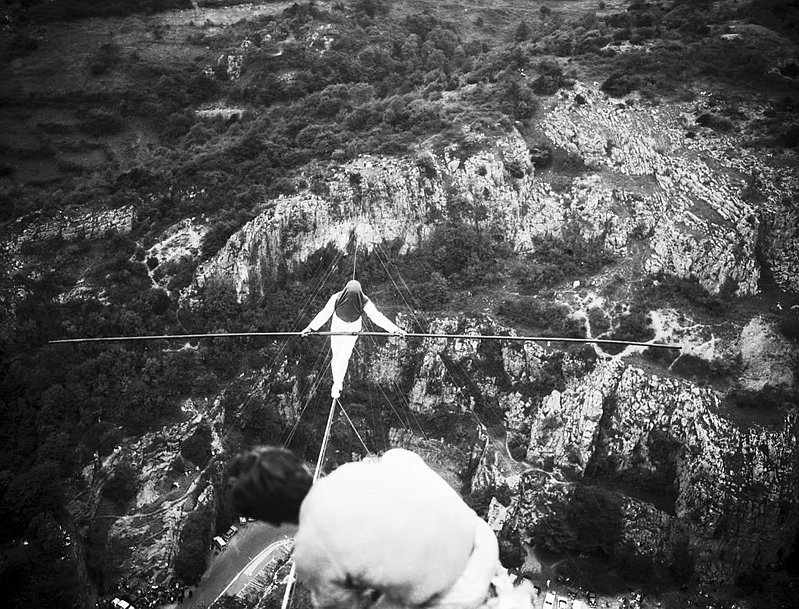
Rudy Omankowski, photo: Paul Townsend, CC BY-NC-SA 2.0Rudy Omankowski, photo: Paul Townsend, CC BY-NC-SA 2.0 “A very skilled young man, that had both the physical ability and the psychic strength to do extraordinary things. As a young man he trained himself to perform by performing in the streets, he sky walked illegally between towers in Paris where he lived, but first when he walked between the Twin Towers in New York in August 1974. It was partly filmed, and created a scandal that made him well-known.”
Jayanta Chakrabarty from India sent a long answer:
“Rudolf Otto Omankowsky Jr born in Prague in 1937 into a long line of circus and highwire performers rose to become the most illustrious modern tightrope walker. Counselled by his father from the tender age of three years on highwire walking he followed the footsteps of his parents who were among the famous Czech artists requisitioned during the War in Germany and later in France.
“In 1950, ‘Papa Rudy’ as he was affectionately called succeeded his father as head of the appropriately named ‘White Devils’ group of acrobats. This much sought after group toured important cities of France, Denmark, Italy, Germany, Britain and even parts of Asia performing incredible balance walk shows on unicycles, threesome pyramid cycles and other acrobatic shows. Rudy himself specialized in somersault in single bicycle over four partners. His notable performances include the 1959 and 1961 tightrope walk across the 200 m Cheddar Gorge in Somerset without using a net. In 1962 he stunned the world by his 1.25 km long skywalk over the Gerardmer Lake in Les Vosges, eastern France, situated between two mountain tops of 240m and 200 m high. This being the longest skywalk ever made blindfolded earned him the title of World Champion.”
Mary Lou Krenek from the US writes:
“Rudy Omankowski, Jr. is a France based highwire walker born on 1 January 1937 in Czechoslovakia into a long line of circus and highwire performers.
“He holds a record for skywalk distance he achieved for his 1.25 km skywalk between two mountaintops in Gerardmer, les Vosges, France. Omankowski also walked acress Cheddar Gorge, Cheddar in Somerset, England in 1959 and again in 1961. He did not use a net.
“Papa Rudy as he is affectionately referred to by his students, mentored Philippe Petit, a French highwire walker who is famous for his walk between the towers of the World Trade Center in New York City in 1974. A popular movie, ‘The Walk’ was made of this experience with actor Sir Ben Kingsley playing the supporting role of Papa Rudy.”
Thank you very much indeed for all your answers and this time our little prize goes to Arne Timm from Estonia. Congratulations! And for the rest of you who haven’t been lucky this time, there’s a brand new mystery person to disclose.
In January we would like to know the name of the Czech-English social anthropologist and philosopher who was born in 1925 in Paris and died in Prague in 1995. He is considered as one of the foremost experts on the subject of nationalism.
Please send us his name to english@radio.cz by January 27th. That is also the address for your questions, comments and reception reports. Mailbox will be back again in four weeks’ time. Until then, happy listening and take care.

Winners Of December 2015 Radio Prague Quiz

 
The correct answer for December:

Miroslav Zikmund and Jiří Hanzelka


Winners:
Jean-Michel Aubier, France
Jutta Frank, Germany
Lucas Arthur Santos Gomes, Brasil
Willy Hillhorst, Netherland
Aleksandr Fedorovich Yudin, Russia
Lenka Machová, Czech Republic

Radio Prague's Monthly Quiz January2016

Test your knowledge of things Czech! On the first day of the month Radio Prague will announce the month’s quiz question on this site. At the end of every month we will draw six winners from the correct answers received. Join our contest and win a Radio Prague prize! Answers should be sent to cr@radio.cz by the end of the month.
The winners will be featured on this site.
Question for January:
The Czech Philharmonic Orchestra was established 120 years ago and its first concert took place on January 4, 1896 at the Rudolfinum concert hall in Prague. Tell us the name of the Czech composer who conducted this first concert.

Friday, 1 January 2016

The Sound Kitchen

SATURDAY 26 DECEMBER 2015
Utopia … and a move towards it from Pakistan
David Franklin/Getty Images/A Terrade
By Susan Owensby
This week on The Sound Kitchen, you’ll hear the answer to the question about Utopia. There’s a surprise from Pakistan, plenty of great music, and of course, the new quiz question. So click on that little “Listen” arrow above, and join in!
Hello everyone!
Welcome to The Sound Kitchen. You can catch the programme on-the-air every Saturday, at 6:15, 7:15, 14:45 and 16:45 universal time. You’ll hear the winner’s names announced and the week’s quiz question, along with all the other ingredients you have grown accustomed to: your letters and essays, “On This Day”, quirky facts and news, interviews, and great music … so be sure and tune in every Saturday.
DOSSIER: PAKISTAN GENERAL ELECTION 2013
Fabulous news! We have a shortwave frequency again! It’s 9675 kHz on the 31m band, and you can hear us between 6.00 and 7.00 UT every day. We’ve had reception reports from Algeria, Australia, Bangladesh, Canada, China, Cuba, Denmark, Germany, India, Indonesia, Japan, Kazahkstan, Latvia, Lithuania, the Netherlands, New Zealand, Nigeria, Pakistan, Peru, Sierra Leone, Sweden, the United Arab Emirates, the UK and the US, and although the frequency is “aimed” (or however that works) towards the African continent, give it a try. You never know … and be sure and send us your reception reports. Maybe we can get more time, which would be wonderful.
You can also look for our programs on WRMI (http://www.wrmi.net/) and WRN (http://www.wrn.org/listeners/). In Paris, you can hear us on World Radio Paris (http://www.worldradioparis.fr/) on DAB+. These broadcasters diffuse our programs out of the goodness of their hearts (and thank you thank you thank you WRMI, WRN, and World Radio Paris!), but unless you tell us how you heard us, we have no way of knowing … so do write and tell us how you listen to us.
This week’s quiz: On 21 November, I asked you about the word “Utopia”. I asked you to tell me what “Utopia” means and who invented the word, or more exactly, put two existing words together to create it. You were also to tell me when it was first used.
The answer is: Utopia means “no place”. The 16th century English statesman Thomas More is the person who coined the phrase, by putting together the Greek words for “no” and “place”. Utopia was the title of his 1516 book about a fictional island society in the Atlantic Ocean, which described an ideal society.
The winners this week are: Four RFI Club members: Mrs Pavai Babu from Coimbatore, India; Shamim Ahmed Sonju from Rangpur, Bangladesh; Samboujang Touray from Serre Kunda, The Gambia; Hans Verner Lollike from Hedehusene, Denmark and finally (ready to join up, Joseph?) Joseph Okao from Kampala, Uganda.
 Congratulations winners!
This week’s question ... you'll have to listen to the show to participate. You have until 1 February to enter this week's quiz. The winners will be announced on the 6 February program. When you enter, be sure you send your postal address in with your answer, and if you have one, your RFI Listeners Club membership number.
Send your answers to:
english.service@rfi.fr
or
Susan Owensby
RFI – The Sound Kitchen
80, rue Camille Desmoulins
92130 Issy-les-Moulineaux
France
or
By text … You can also send your quiz answers to The Sound Kitchen mobile phone. Dial your country’s international access code, or “ + ”, then 33 6 31 12 96 82. Don’t forget to include your mailing address in your text – and if you have one, your RFI Listeners Club membership number.